6 Aug 2026
Wearable Sensors Redefine Odds Formulation in International Sports Markets
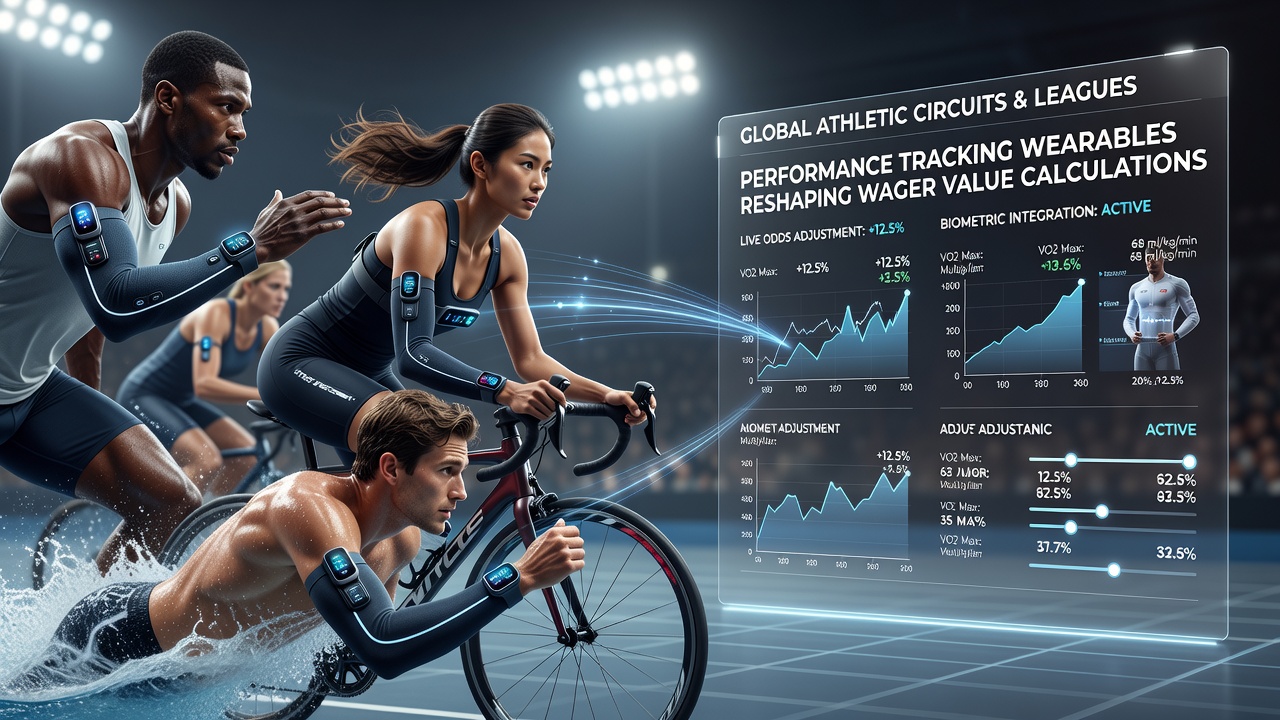
Performance tracking wearables collect continuous streams of biometric and kinematic data that analysts integrate into statistical models used for wager valuation across professional leagues and circuits, and these systems have expanded rapidly since the mid-2020s as hardware costs declined and connectivity improved. Teams in basketball, football, cricket, and tennis now equip athletes with chest straps, wrist units, and embedded insoles that record heart-rate variability, acceleration profiles, and positional coordinates at frequencies exceeding 100 hertz, while bookmakers and data syndicates receive anonymized aggregates through secure application-programming interfaces that update every few seconds during live events.
Data Integration in Live Markets
Operators combine wearable outputs with traditional box-score statistics to recalibrate implied probabilities in real time, and this fusion produces narrower margins on totals and player-prop markets because deviations from expected workload or recovery metrics become visible earlier. In August 2026 several European basketball leagues began publishing standardized load-index figures derived from wearable accelerometers, allowing pricing engines to adjust over/under lines on points scored within quarters when a star player's internal-load reading exceeded pre-game baselines by more than fifteen percent. Similar feeds operate in Australian cricket franchises where GPS-derived sprint counts influence live odds on run totals during power-play overs, creating a feedback loop that incorporates fatigue indicators previously unavailable to oddsmakers.
Regional Adoption Patterns
North American major-league organizations adopted chest-worn monitors earlier than most international bodies, yet European football clubs accelerated deployment after 2024 rule changes permitted sideline data transmission during matches. Researchers at the University of Queensland documented a twelve-percent increase in the granularity of expected-goals models once wearable-derived acceleration thresholds replaced manually coded high-intensity runs, and those refinements flowed directly into pricing algorithms used by Asian betting exchanges. Canadian regulatory filings show that sportsbooks operating under provincial licenses began citing load-management data as a factor in prop-market suspensions when multiple starting players recorded elevated neuromuscular-fatigue scores within a single game week.

Impact on Player-Prop Valuation
Player-specific markets experience the most pronounced recalibrations because wearables isolate individual movement signatures that correlate with scoring efficiency or injury risk. A forward in European football whose average top-speed drops below ninety-five percent of seasonal norms receives adjusted line values on anytime-goal wagers, while tennis players whose serve-velocity decay exceeds historical patterns see live-set totals shift within the first service game. Observers note that these adjustments occur within ninety seconds of data ingestion, compressing the window during which sharp bettors can exploit discrepancies between public perception and updated probabilities.
League Governance and Data Standards
Governing bodies have responded with data-sharing protocols that balance competitive integrity against commercial interests, and the International Basketball Federation introduced a 2025 mandate requiring clubs to transmit standardized wearable metrics to a central repository accessible to licensed data providers. Australian cricket boards followed with a voluntary framework that anonymizes individual identifiers while preserving aggregate workload distributions used by pricing teams. These policies reduce information asymmetry across markets yet preserve competitive edges for organizations that develop proprietary algorithms capable of weighting variables such as recovery-heart-rate slopes or ground-contact-time asymmetries.
Future Infrastructure Developments
Hardware manufacturers continue to miniaturize sensors and extend battery life, enabling continuous monitoring through multi-day tournaments without recharging cycles, and software platforms now incorporate machine-learning layers that flag anomalies in movement patterns before they translate into performance drops. In August 2026 several tennis governing bodies plan pilot programs that feed wrist-sensor data directly into electronic line-calling systems, creating an additional data layer for in-play wager adjustments on service-hold percentages. Such integrations illustrate how performance-tracking ecosystems evolve from post-match review tools into foundational inputs for real-time market pricing across continents.
Conclusion
Performance-tracking wearables supply granular physiological and kinematic datasets that reshape the mathematical foundations of wager valuation in professional sports, and the pace of adoption indicates continued convergence between athlete-monitoring systems and global betting infrastructure through at least the remainder of the decade.